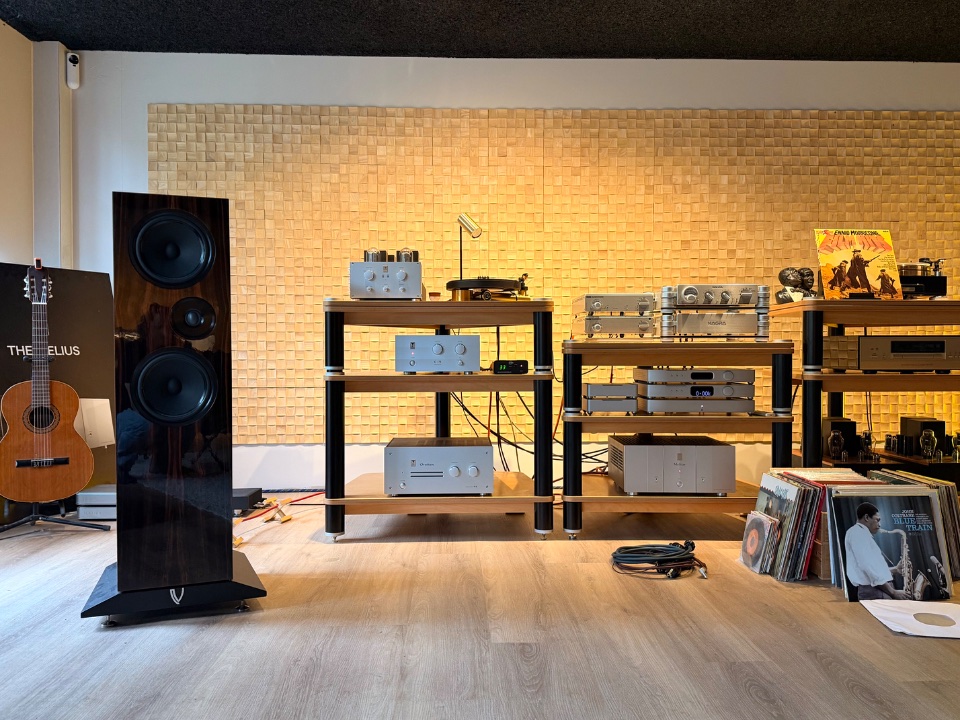
Recently, I’ve been listening a lot to this particular combination: the Living Voice R80 speakers, driven by the Kondo G-72i pre-amplifier and Kondo Melius power amplifier.
And this is one that’s here to stay for the time being!
The R80 lets you hear what’s going on
The Living Voice R80 is an interesting loudspeaker. Anyone familiar with Living Voice from, for example, the Auditorium, IBX or OBX models will immediately recognise something. That natural way in which voices and instruments are reproduced, the timing and, above all, the ease with which music seems to come to life.
But the R80 takes it a whole step further.
The loudspeaker utilises two 21 cm Scan-Speak Ellipticor bass/midrange drivers flanking a 34 mm Ellipticor tweeter. With a sensitivity of 92 dB and a nominal impedance of 6 ohms, the R80 has also been deliberately designed to work well with valve amplifiers.
It looks promising on paper. It’s only when you listen to it that you realise why.
The R80 has a sense of scale and authority that you don’t find in this way with the smaller Living Voice models. The bass goes deep, but what appeals to me most is that the bass doesn’t sound like a separate element of the soundstage. Everything remains a single, cohesive whole.
And perhaps even more importantly: the R80 makes it very easy to hear exactly what you’ve connected to it.
That can make it merciless at times, but with the right electronics, it’s actually particularly rewarding.
Kondo G-72i
For the preamplification, we’re using the new Kondo G-72i.
The G-72i is built around four 6072 double triodes and utilises Kondo’s own silver components, including silver-foil capacitors, silver resistors and SSW silver internal wiring. The entire circuit is hand-built around a copper chassis.
But ultimately, what interests me most is what happens when you play music.
And what really stands out is just how much tranquillity the G-72i brings.
Not the sort of tranquillity where dynamics are smoothed out or the sound is made more ‘friendly’. On the contrary. In fact, subtle dynamic changes become easier to hear. A singer starting a little louder, the touch of a piano, a drummer using just a touch more force: it all happens without giving you the impression that the system is deliberately trying to draw your attention to it.
I think that’s perhaps one of the greatest qualities of good Kondo electronics.
The detail is there, but it doesn’t constantly demand attention.
32 watts. And that’s all we need.
Behind it all is the Kondo Melius.
A stereo EL34 push-pull power amplifier delivering 32 watts per channel.
In a world where amplifiers delivering hundreds of watts have become almost the norm, 32 watts might sound modest. With the Living Voice R80, however, it proves to be more than enough in practice.
Living Voice has paid close attention to the impedance response of the R80. The load remains relatively manageable, and it is precisely for this reason that an amplifier like the Melius feels particularly at home here.
And you can hear it.
The combination offers speed and control, but never in a forced way. The bass has weight when the recording calls for it, whilst voices and acoustic instruments retain a wonderful richness of timbre.
That last point, in particular, is important to me.
A cello shouldn’t just sound bass-heavy. You want to hear the body, the string, the bow and, ultimately, the musician.
With this combination, that’s exactly what happens.
Not spectacular. But impressive.
What perhaps strikes me most after listening for a while is that this set doesn’t constantly try to show off how good it is.
There’s no exaggeratedly wide stereo image. No artificially boosted treble. No bass that feels the need to remind you on every track that there are two hefty woofers in the cabinet.
Instead, something else emerges.
A sense of naturalness.
Put on a small jazz ensemble and the space feels smaller and more intimate. Put on a large orchestra and the room suddenly seems to become a lot bigger. A good live recording captures the acoustics of the venue, whilst a dry studio recording is allowed to sound just as dry.
That seems logical, but in practice it’s one of the hardest things to achieve with an audio system.
The danger of ‘just one more track’
When tuning a system, I often listen to short clips. Just to check what a different cable does, adjust the position of the speakers by a few centimetres, or see what happens with a different source.
With this combination, that doesn’t always work.
You put a track on to check something and twenty minutes later you realise you’ve simply been listening to music.
And then comes another record.
For me, that’s ultimately a far more important yardstick than any technical detail whatsoever.
A good system lets you hear what it’s capable of.
A really good system makes you forget it’s even there.
Why this combination works
The Living Voice R80 has sufficient transparency to fully reveal the qualities of the Kondo electronics, whilst at the same time possessing the natural timbre and dynamic freedom that these amplifiers require.
The G-72i brings calm, space and refinement. The Melius adds to that the speed, control and beautiful harmonic richness of its EL34 push-pull circuit. And the R80 seems to want to interfere remarkably little with that.
On paper, the system consists of three separate components.
When listening, it doesn’t feel that way.
And that, in my view, is ultimately what it’s all about.
Not hearing the loudspeaker. Not hearing the amplifier. Not worrying about cables, valves or specifications.
But simply wanting to play that one recording again.
A lifetime of listening.
The Living Voice R80, Kondo G-72i and Kondo Melius are available for listening at Highender Audio in Doetinchem. We’d be delighted to demonstrate this combination by appointment, naturally with your own favourite music.
← All articles