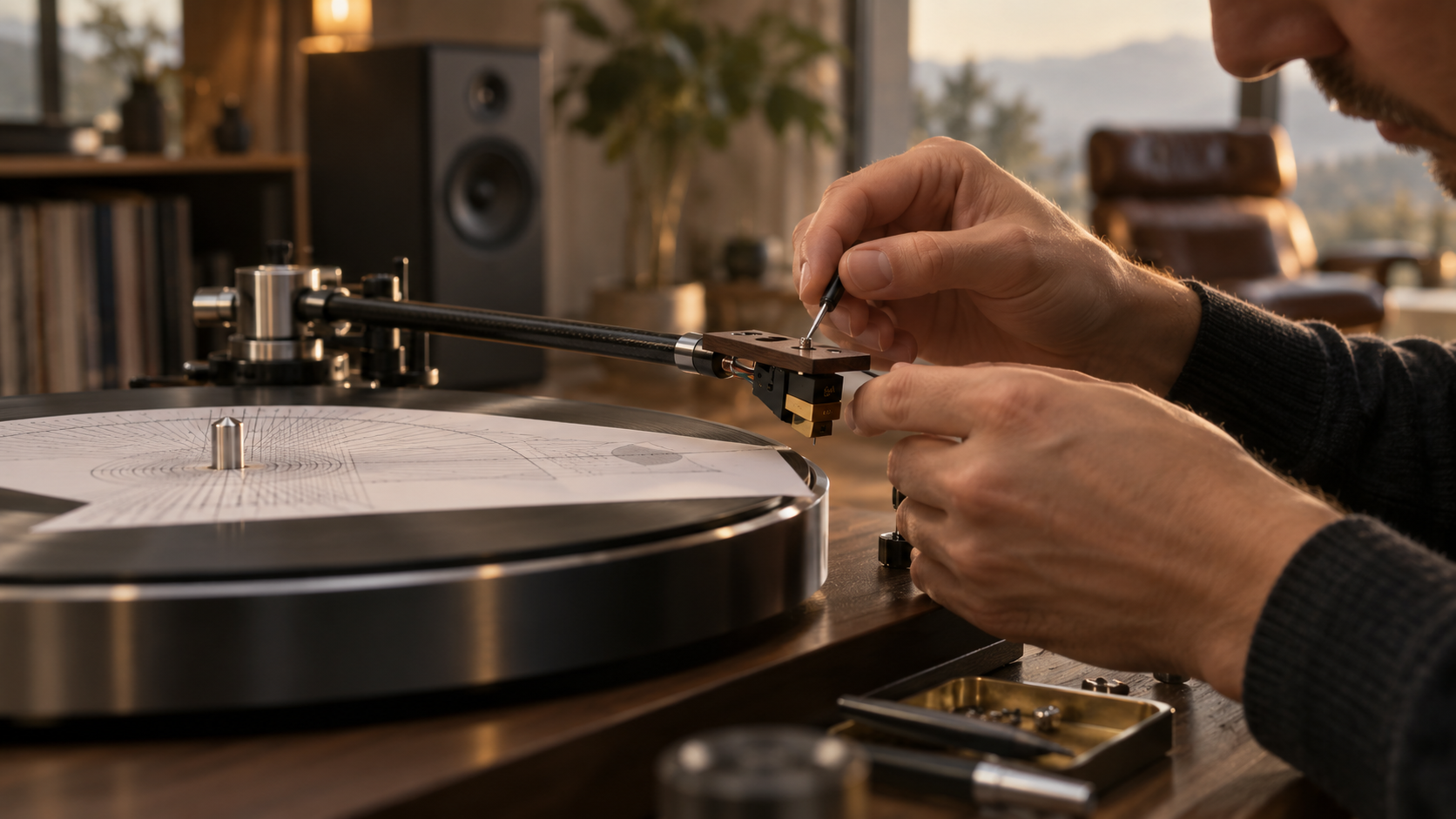
Fitting a new component under a record player seems like the sort of job where you think beforehand: how complicated can it be? Two screws, four wires, adjust the stylus pressure and off you go.
Until you actually get started.
Then it suddenly turns out that ‘more or less right’ is actually just wrong when it comes to vinyl.
It starts with the position of the cartridge in the headshell. A millimetre forwards, turned a fraction to the left, then back again a little. Then you put the template on, peer at the lines and start all over again because the cantilever isn’t quite parallel. It’s not the cartridge housing that matters, but ultimately the stylus and cantilever themselves. And those aren’t always easy to assess.
It’s typically the sort of task where, after twenty minutes, you think it’s perfect, only to realise five minutes later that you were looking at it at an angle.
And yet all that fiddling is worth the effort.
A cartridge that isn’t properly aligned may sound quite good at first. Certainly at the start of a record. But as you get towards the inner grooves, the difference often becomes more apparent. Vocals take on a sharp edge, the calm disappears and a busy passage suddenly becomes just that bit more unsettling. That’s exactly the annoying thing: you then find yourself wondering whether it’s down to the record, the cartridge, the phono stage or perhaps even the recording itself.
When in fact the cartridge is simply half a millimetre out of position.
Then there’s the needle pressure. Another aspect you can have great fun tinkering with. The manufacturer specifies, for example, 1.8 to 2.2 grams, and at some point the thought creeps in that 1.8 grams probably sounds more refined. Less pressure, so more air, right?
Not necessarily.
Setting it too lightly can actually result in less control and more distortion. That’s why I prefer to start around the middle of the recommended range and listen my way from there. A digital tracking force gauge is actually indispensable here. Relying on the scale on the counterweight is all well and good, but if you’re going to the trouble anyway, you might as well do it properly.
And we’re not nearly done yet.
The height of the tonearm – VTA – can also make quite a difference. A very small change can make a system sound just a little more open, fuller or smoother. That makes it tempting to use VTA as a sort of tone control. Still, I try to avoid that. First, set it up as technically correctly as possible; only then do I fine-tune by ear.
Azimuth is perhaps even trickier. Viewed from the front, you want the stylus to sit as straight as possible in the groove. Even a minimal deviation can affect channel separation and imaging. Certainly in a transparent system, you hear this not just as the left or right channel being louder, but above all as a stereo image that doesn’t quite come into its own.
And finally, anti-skating. There are whole philosophies surrounding this too. Exactly the same as the stylus pressure, slightly less, by ear, using a test record… You could spend an entire evening on it.
Perhaps, in the end, that’s exactly what makes analogue so much fun.
You plug in a streamer and it just works. With a record player, you sometimes have to spend an hour on your knees, fetch a torch, take three measurements and ask yourself why on earth you ever got yourself into this.
But then you put that record on one more time.
Suddenly, the vocals are more settled in the centre. The cymbals sound cleaner. The bass gains more definition and the stereo image widens without becoming more pronounced.
Not an earth-shattering difference.
But just enough to put on one more record.
And after that, you’ll probably end up adjusting the stylus pressure to 0.05 grams anyway.
← All articles